
Fire Cupping: Ancient Flame, Modern Physiology
Let’s talk about what it really is, how it works, and why I believe it deserves a place in the modern wellness conversation.

An article by Assunta
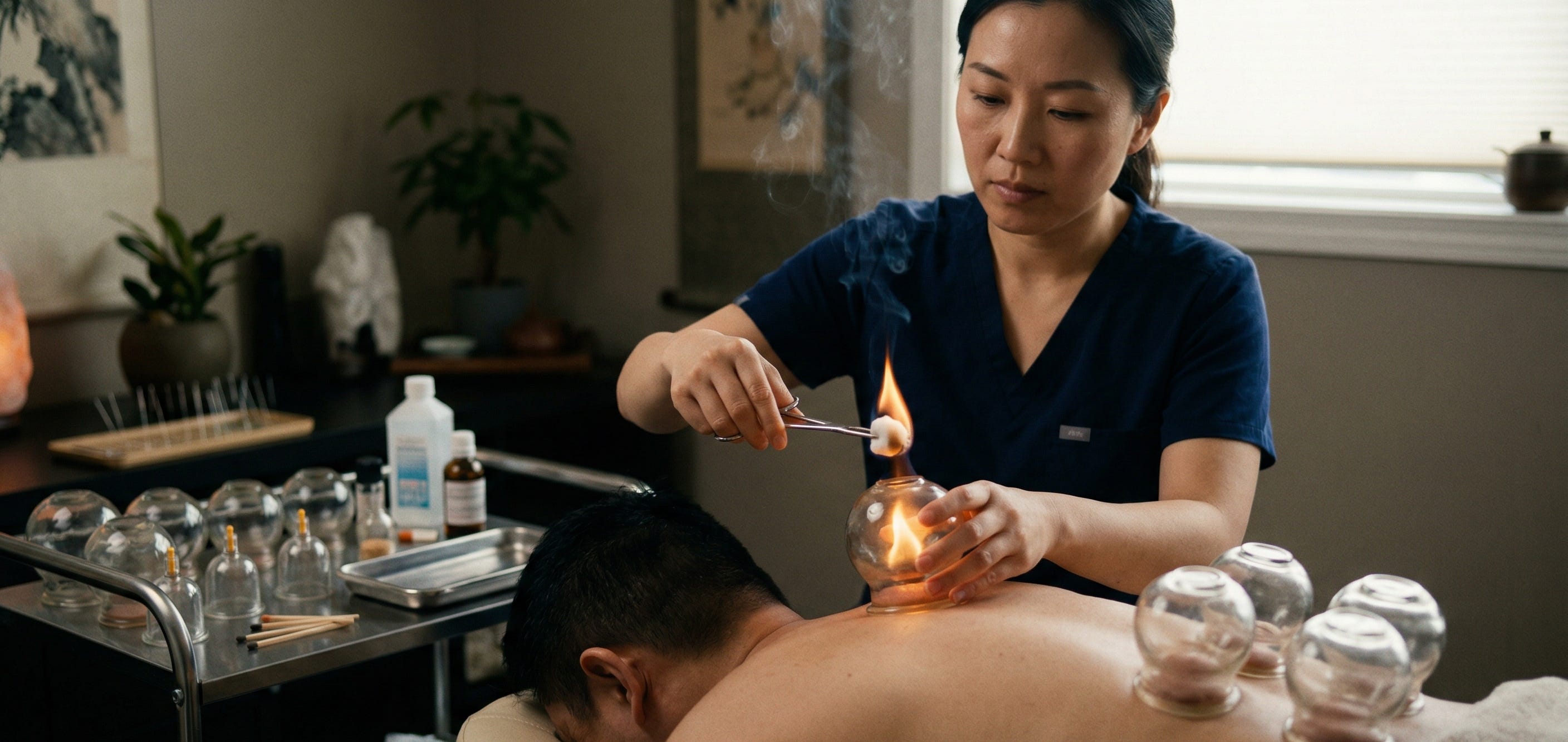
There’s something almost sacred about fire.
It warms.
It transforms.
It awakens.
And when used intentionally in therapy — it heals.
If you’ve ever seen circular marks on someone’s back and wondered what they were from, you were likely looking at fire cupping — an ancient healing practice that has been used for thousands of years in Traditional Chinese Medicine and other cultural systems across the world.
Let’s talk about what it really is, how it works, and why I believe it deserves a place in the modern wellness conversation.
What Is Fire Cupping?
Fire cupping uses glass cups and a flame to create suction on the skin.
A practitioner briefly places a flame inside the cup to remove oxygen. As the air cools, a vacuum is created. The cup is then placed on the body — most often the back, shoulders, or neck — where it gently lifts the skin and superficial muscle tissue upward.
Unlike massage, which presses down into tissue, cupping decompresses.
It lifts.
It draws.
It pulls stagnation to the surface.
The circular marks that appear afterward are not bruises in the traumatic sense. They are a sign of increased blood flow and the movement of stagnant fluids.
They typically fade within several days.
How Fire Cupping Works (The Physiology)
Let’s break this down in modern terms.
When suction is applied to tissue:
1. Microcirculation increases.
The negative pressure draws blood to the surface, increasing local circulation and oxygen delivery.
2. Fascial adhesions begin to release.
Fascia — the connective tissue surrounding muscles — can become tight and restricted. The lifting motion of cupping creates space and mobility within that tissue.
3. The parasympathetic nervous system activates.
Many people report deep relaxation during and after cupping. This may be due to nervous system modulation and decreased sympathetic “fight-or-flight” tone.
4. Inflammatory mediators are stimulated in a controlled way.
Similar to exercise or dry needling, cupping creates a mild, intentional inflammatory response that signals repair and recovery.
5. Lymphatic flow improves.
The lymphatic system relies on movement and pressure gradients. Cupping helps encourage that flow, supporting the body’s natural detox pathways.
This isn’t about “pulling toxins out of the skin” — a phrase often oversimplified.
It’s about improving circulation and supporting the systems already designed to detoxify you: liver, kidneys, lymphatics.
What Fire Cupping Can Help With
Traditionally and clinically, fire cupping is often used for:
• Chronic neck and shoulder tension
• Back pain
• Headaches and migraines
• Athletic recovery
• Respiratory congestion
• Stress-related muscle tightness
• Limited range of motion
I’ve seen it be especially helpful for people who carry stress in their upper back — which, let’s be honest, is most of us.
Modern life keeps us forward-flexed, phone-bent, desk-bound.
Cupping helps open the front body and decompress the back body.
It creates space where there was compression.
Why the Marks Look Darker in Some Areas
This is one of the most common questions.
The darker the mark, the more stagnation was likely present in that area — meaning circulation may have been compromised or tension had been chronic.
The color variations are influenced by blood flow, capillary response, and tissue congestion — not necessarily “toxins.”
The marks fade as circulation normalizes.
What’s left behind is often:
Less stiffness
Improved mobility
A lighter, more open feeling in the body
Fire Cupping vs. Modern Recovery Tools
Today we see suction tools in physical therapy, silicone cups in athletic training rooms, and vacuum-assisted fascia devices in high-end wellness clinics.
The principle is the same.
Fire cupping is simply the traditional version.
Ancient medicine understood something we are now re-learning:
Circulation is life.
Where blood flows, healing follows.
Who Should Avoid Fire Cupping?
While generally safe when performed by a trained practitioner, fire cupping is not appropriate for everyone.
Avoid or consult a healthcare provider if you:
• Have bleeding disorders
• Are on blood thinners
• Have fragile or compromised skin
• Are pregnant (certain areas should be avoided)
• Have severe anemia
• Have active infections or open wounds
As always — health is personal. One person’s therapy is another person’s contraindication.
The Emotional Component
Something I find fascinating is how often people feel an emotional release after cupping.
Shoulders drop.
Breathing deepens.
Tears sometimes surface.
Is it biochemical? Nervous system related? Fascial memory? A combination?
We don’t fully understand it yet.
But what we do know is that the body stores stress physically.
And when tissue decompresses, the nervous system often follows.
Why I Love Practices Like This
Fire cupping reminds me that healing doesn’t always require something synthetic or complicated.
Sometimes it requires stimulation.
Circulation.
Intentional stress followed by recovery.
The body is brilliantly designed.
It simply needs signals.
When we improve microvascular function and tissue mobility, we create an internal environment where healing can occur more efficiently.
That’s powerful.
My Invitation to You
If you’ve been feeling:
Tight in your upper back
Stiff through your shoulders
Heavy with stress
Limited in movement
Consider exploring fire cupping with a qualified practitioner.
Ask questions.
Understand the process.
Notice how your body responds.
We don’t heal by ignoring stagnation.
We heal by moving it.
And sometimes, a little controlled fire is exactly what awakens the system.
References
Cao H, Li X, Liu J. An updated review of the efficacy of cupping therapy. PLoS One. 2012.
Teut M, et al. Pulsatile dry cupping in chronic low back pain: A randomized controlled trial. BMC Complementary Medicine and Therapies. 2018.
Lowe DT. Cupping therapy: An analysis of the effects of suction on skin and underlying tissues. Journal of Alternative and Complementary Medicine. 2017.
Bordoni B, et al. Fascial tissue research and manual therapy. Journal of Multidisciplinary Healthcare. 2014.